







Cross-marking and standardisation.
Check your marks are fair and consistent before they go to the exam board. Askel helps you pick the sample, hides names behind candidate letters, and keeps every mark change and reason in one standardisation record.
A careful check protects every student’s mark.
If the moderator’s sample is out of line, the board can change the whole cohort’s marks, not only the sample’s.
Askel makes the school’s own check quick to run and keeps the record, so you can show what you did.
Use the check that fits your department.
For the EPQ and every NEA subject your school marks. A department of one can still standardise, with a partner school.
Trial marking
Everyone marks the same exemplars, then compares with the agreed marks.
How it works Two or more teachersBlind cross-marking
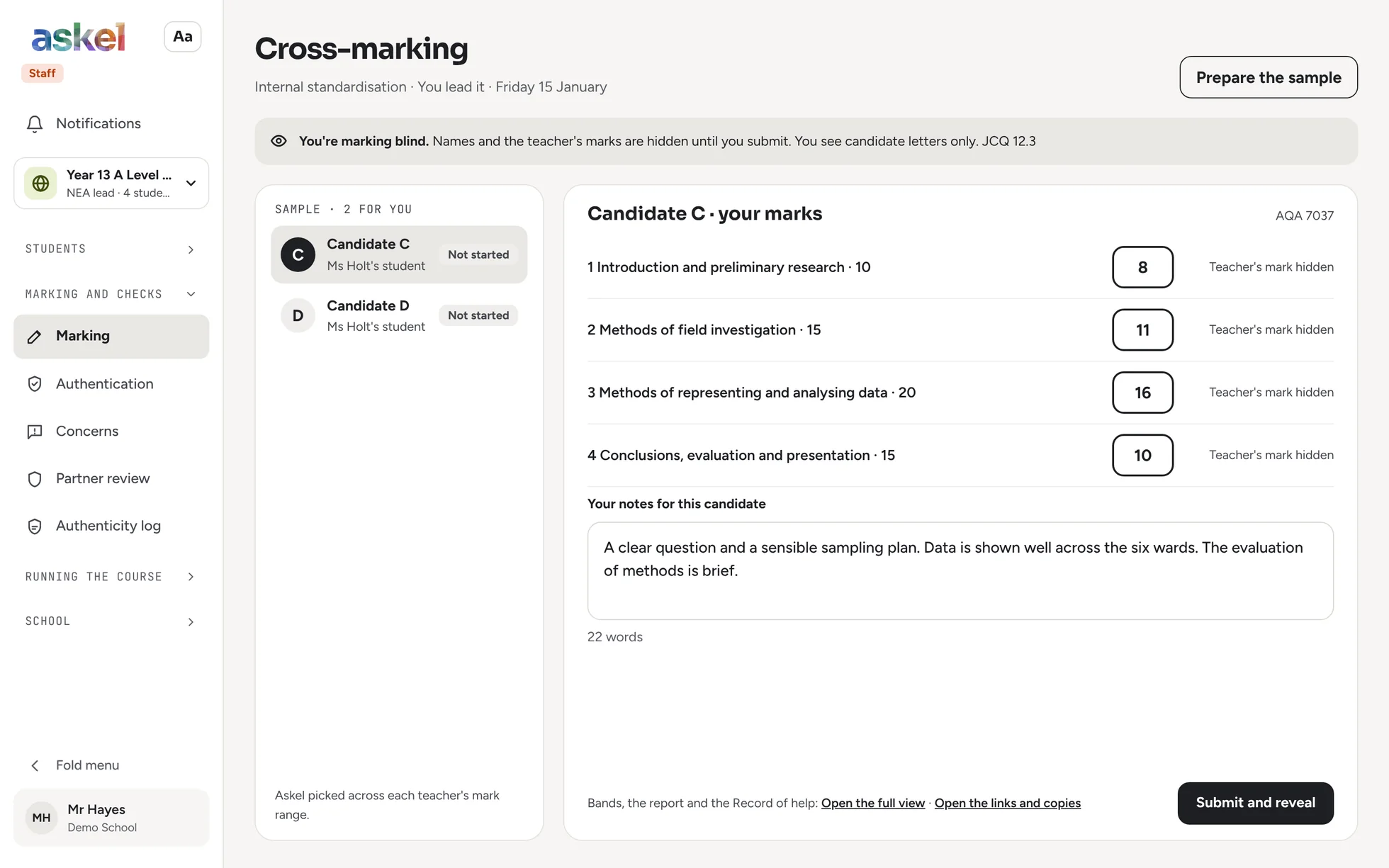
A second teacher marks a sample by candidate letter, then you agree the marks.
How it works Any schoolPartner review
A teacher at another school marks a sample online, with names hidden.
How it works Multi-academy trustsAcross a trust
Pick a partner school in your trust, with no extra sharing agreement.
How it worksMark the board’s exemplars first.
Everyone who supervises marks the same projects, then sees how close they were to the agreed marks.
The coordinator adds 1 to 3 exemplars
With their agreed marks: the board’s exemplars, or last year’s moderated work.
Everyone who supervises marks them once
They see the agreed marks only after they’ve marked, and their marks can’t change after that.
Results show when everyone has marked
So no one is swayed. The coordinator can choose to show marks as they come in instead.
A second teacher marks a sample, by letter.
Once every student has marks, the lead starts cross-marking. The lead is the EPQ coordinator, or the course lead for an NEA subject.
Askel suggests the sample
The highest and lowest mark from each teacher, so the sample covers the whole range. The lead can add to it.
The lead cross-marks blind
Candidates show as letters. Names and the first marks stay hidden until the cross-mark is submitted. The lead’s own students go to another teacher.
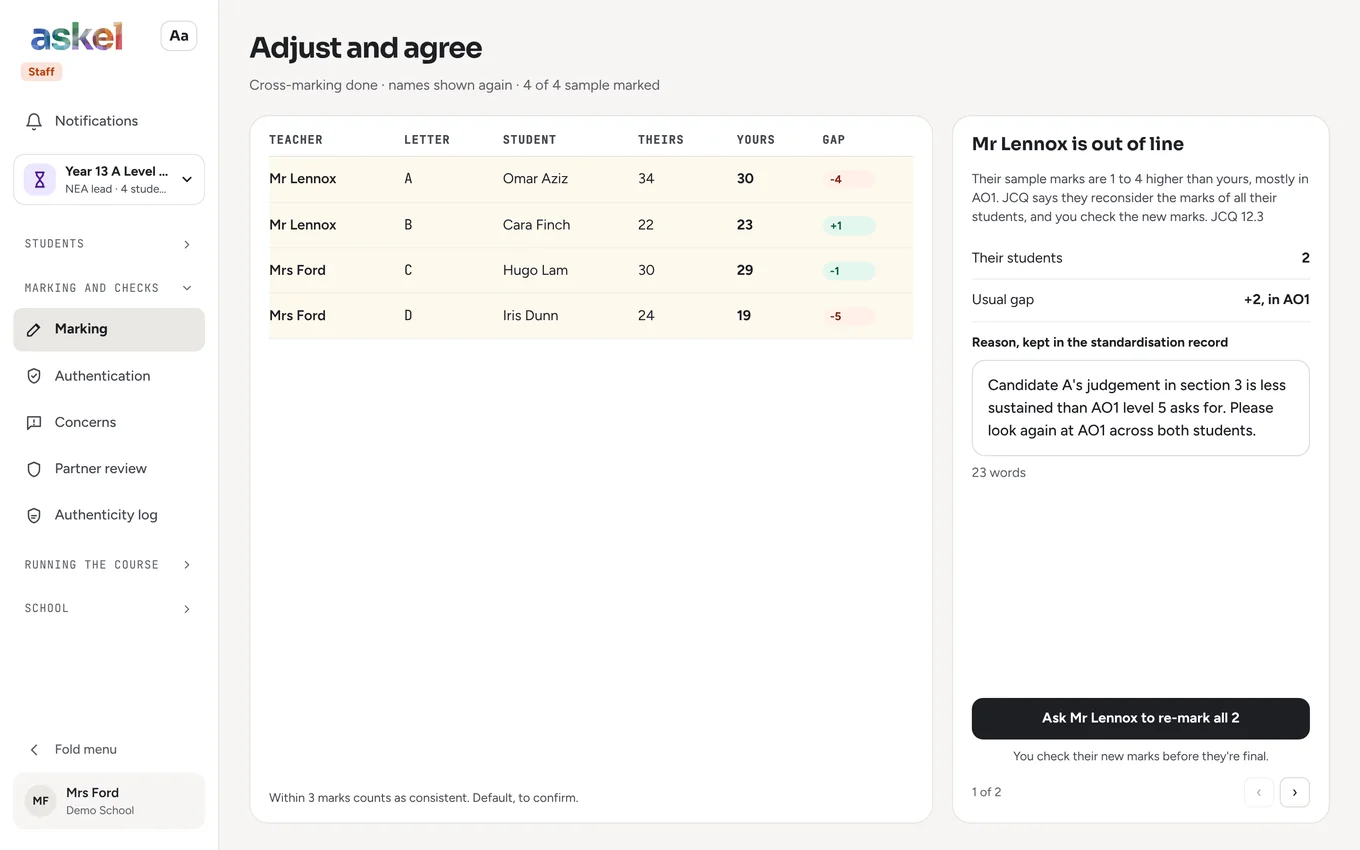
Askel compares the marks
A cross-mark close to the first mark counts as consistent. The scheme recommends the gap: 3 of 50 for the EPQ, 6 of 100 for A Level D&T. The lead can change it, since schools differ.
A teacher whose marks are out of line re-marks
The lead writes the reason, which is kept in the standardisation record, and that teacher looks again at all of their students.
The lead agrees the marks
The lead checks the new marks before they’re final. Every change stays in each student’s mark history.
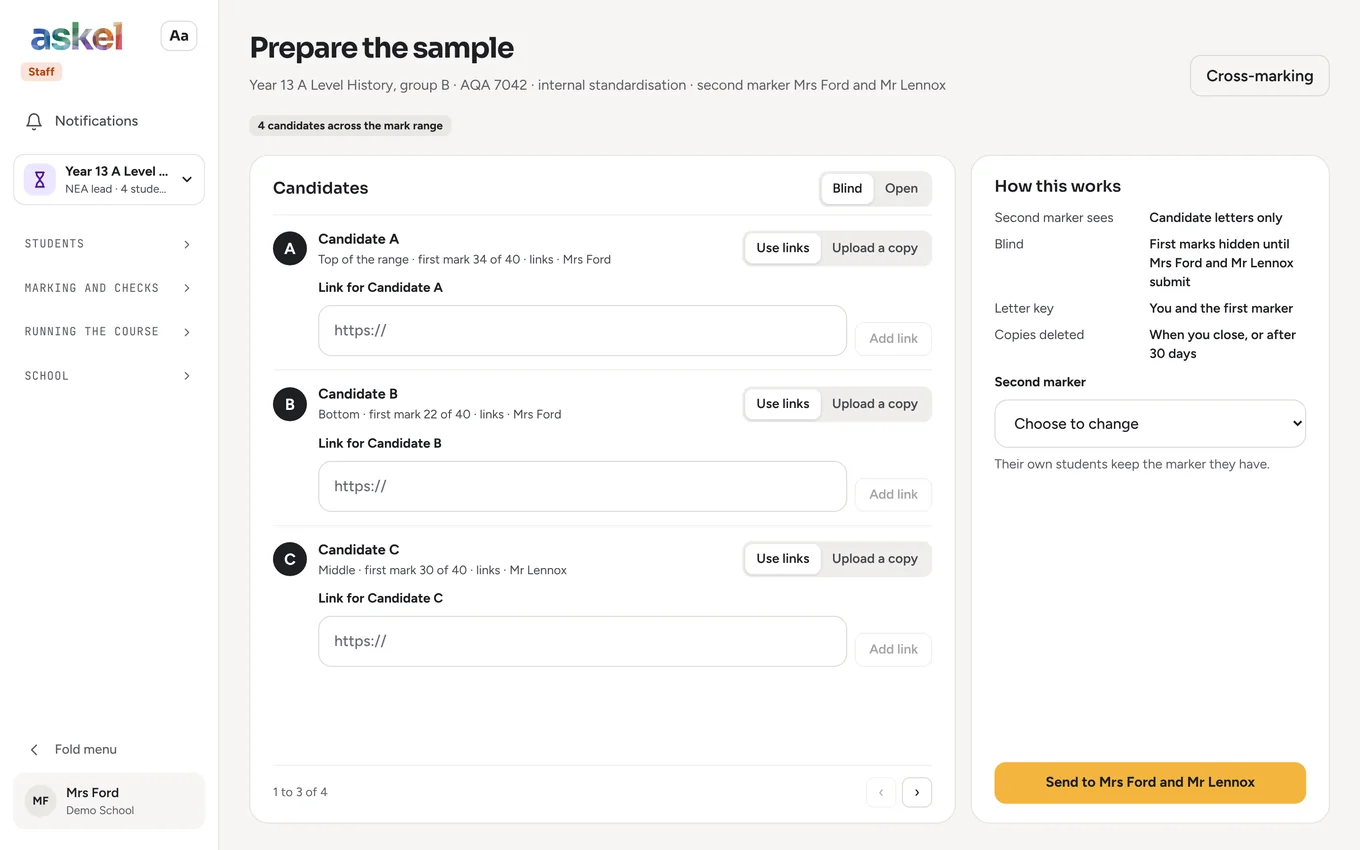
The work: links by default, copies if you need them
For NEA subjects and the EPQ, the second teacher opens the work where your school already keeps it. If they can’t open a link, you can upload a copy for that candidate instead, under their letter. Only teachers on the course can open it. Copies are deleted when standardisation closes, or after 30 days at most, and the record notes the date. For the EPQ, the production log is already in Askel.
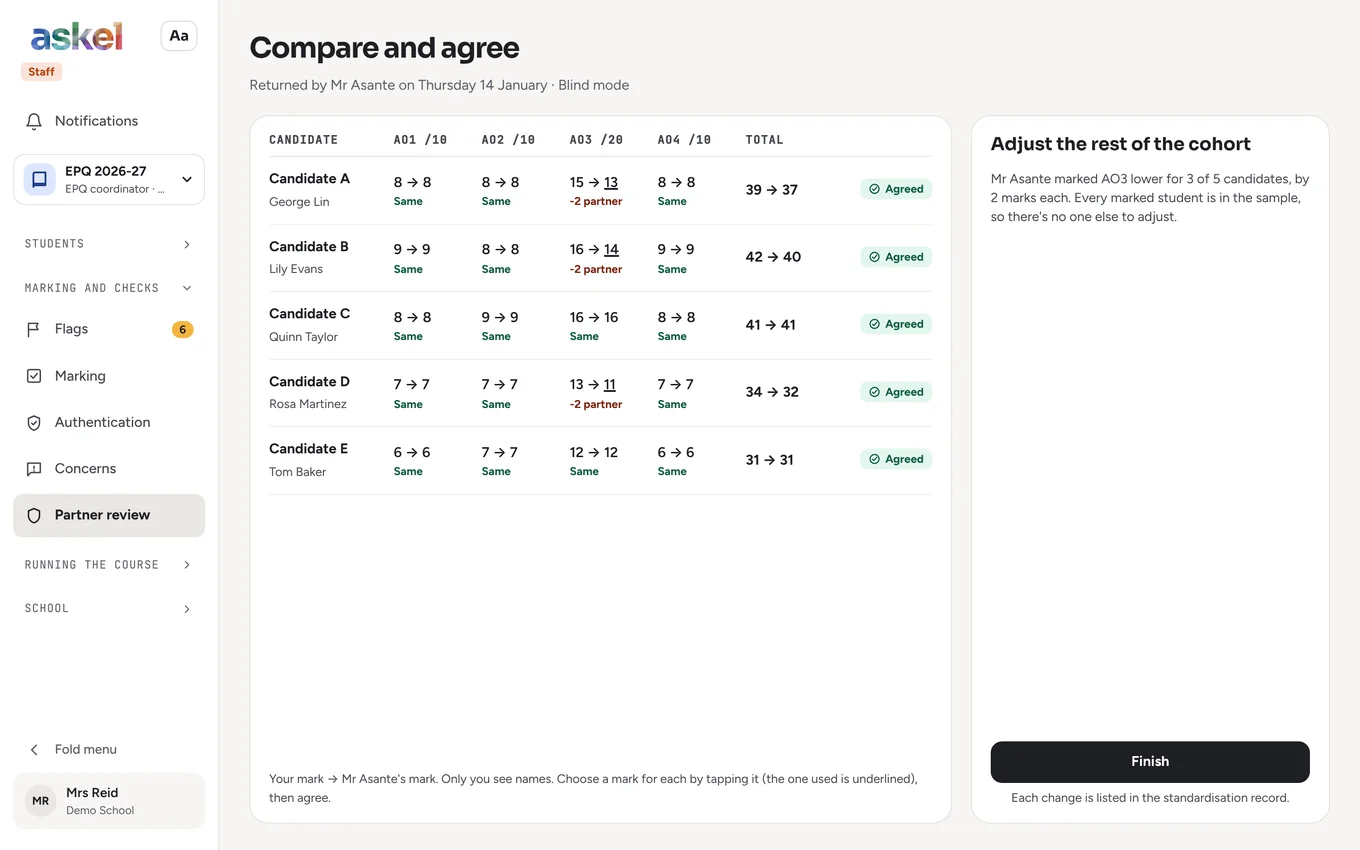
A second opinion from outside your school.
Especially useful when only one teacher marks a subject. A teacher at another school marks a small sample of your work online.
- You choose a sample across the mark range. Students appear as candidate letters, with names hidden.
- The partner signs in through a private link sent to their school email. Access ends after 21 days, or sooner if you end it.
- Blind or open: in blind mode they see your marks only after they submit their own.
- You choose your mark or theirs for each part and agree each candidate. The partner’s marks are advice: you agree your own.
- Closing the review deletes the copies made for it and creates your standardisation record.
Pick a partner school in your trust.
- Schools in the same trust choose each other from their own Partner review page, and run partner review there.
- No extra sharing agreement: the trust’s agreement covers it.
- Each school agrees its own marks, and concerns stay within the school.
- The trust lead sees what each school has completed, such as when it standardised and where its partner review stands. Never the work, the marks or the names.
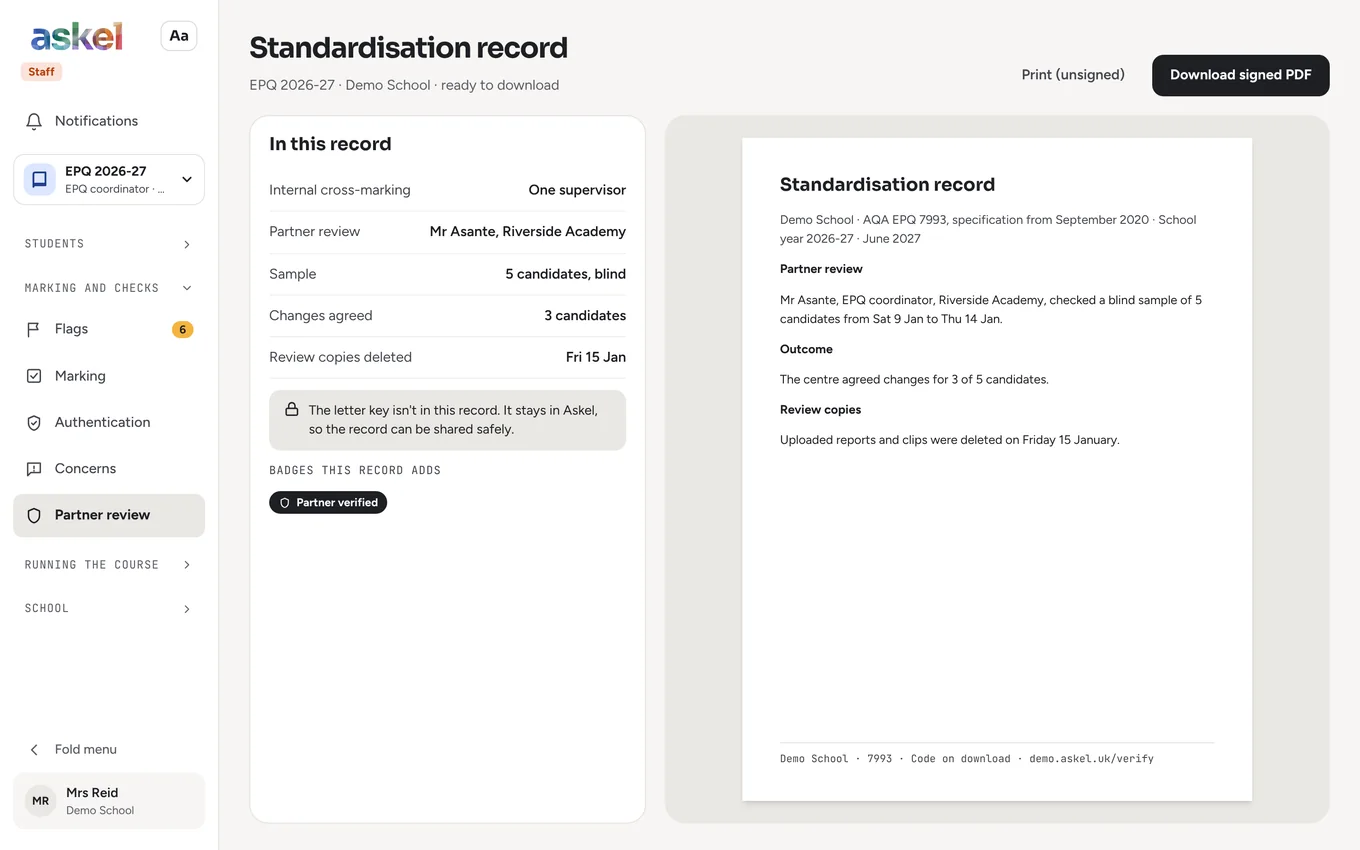
Every change, reason and agreement, kept.
The standardisation record is ready when the exam board or a JCQ inspector asks how you checked your marking.
- Who checked, which sample, and the changes agreed, with reasons
- When the copies made for it were deleted
- No letter key, so the record can be shared safely
- A signed PDF with a code anyone can check
Ready for the board’s moderator.
Once marks are agreed, you can share them with students so they can ask for a review, then send them to the board.
The board’s sample
The Exports page gets the marks and the moderation sample ready to send. For the EPQ, the sample pack follows each board’s file rules: AQA, OCR, Pearson and WJEC/Eduqas.
The EPQ pageVisiting moderators and examiners
Where the board visits, Askel plans the day: a visit plan, a running order and, where the board asks for one, a pack to send before the visit.
PEDrama and DanceArt and DesignQuestions heads of department ask.
No. Cross-marking, trial marking and partner review are your centre’s own check, done before marks go to the board. The board’s moderator still checks a sample and decides whether your marks stand.
With one teacher there’s no one in school to cross-mark. Run a partner review with a teacher at another school, or for the EPQ, trial marking against the board’s marks. Then the coordinator agrees the marks, and the record shows how you checked.
The EPQ and every NEA subject your school marks. Trial marking is for the EPQ. Where the board’s visiting examiner marks the work, as in some Drama, Dance and Music components, the school doesn’t mark it, so there’s nothing to standardise in school. The Spoken Language endorsement has a standardisation trial.
No. They see candidate letters. In school, the letter key stays with the person who set up the check and the first marker. A partner school sees letters too, with names hidden, and the record you keep has no letter key in it.
Askel keeps links to the work, not the files. If you upload a copy under a candidate letter so another teacher can mark it, the copy is deleted when standardisation or the partner review closes, and standardisation copies are deleted after 30 days at most.
Your school accepts Askel’s data terms once. Partner review opens after that. Schools in the same multi-academy trust need no extra sharing agreement: the trust’s agreement covers it.
See cross-marking for yourself.
The staff demo has a second teacher in several subjects, so you can run a round of cross-marking from start to finish.