AQA 7042/C
- Weight and marks
- 20%, 40 marks
- Length or time
- 3,500 to 4,500 words. A hard limit: over length loses 5 marks
- Approval
- Required. Question approval form by 20 October 2026
- Key deadline
- Marks to AQA by 15 May 2027
LaterGCSE Design and Technology, Engineering and Electronics.Planned order, not dates.
All 14 subjectsSee the build orderAskel keeps track of title approvals, sources and draft feedback for the History NEA, following each board’s rules. NEA (non-exam assessment) is coursework marked in school, then checked by the exam board.
Planned order, not dates. Pilot schools can move a subject up.
See the build orderOne row per board, for students sitting in June 2027.
| Board and code | Weight and marks | Length or time | Approval | Key deadline |
|---|---|---|---|---|
| AQA 7042/C | 20%, 40 marks | 3,500 to 4,500 words. A hard limit: over length loses 5 marks | Required. Question approval form by 20 October 2026 | Marks to AQA by 15 May 2027 |
| OCR H505, unit Y100 | 20%, 40 marks | 3,000 to 4,000 words | Required. Titles through OCR’s proposal tool. First-time centres by 31 January 2027 | Marks to OCR by 15 May 2027 |
| Pearson 9HI0/04 | 20%, 40 marks | 3,000 to 4,000 words. Much over 4,000 can’t reach the top level | Optional. Up to 5 titles per form, reply in 10 working days | Marks to Pearson by 15 May 2027 |
Eduqas has no A Level History in England.
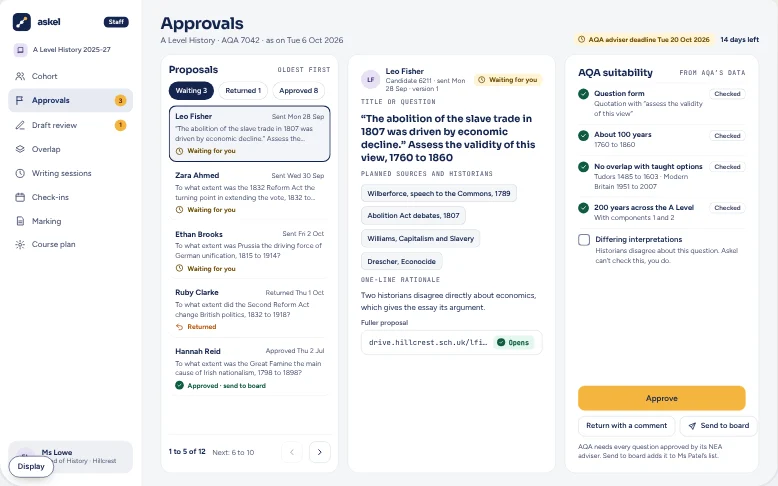
AQA needs every question approved by 20 October. OCR uses its own proposal tool. Pearson’s check is optional.
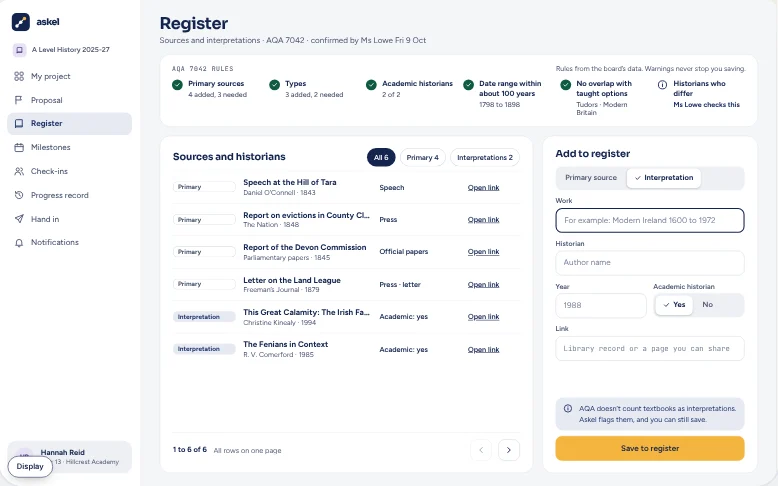
Each board sets how many sources, and what kind. Students in one class mustn’t all use the same ones.
AQA allows no comments on how to improve a draft. OCR allows one general review. Pearson requires a review of the first full draft.
Every feature sits under one of the five steps.
Keeps track of which titles have been approved, and by when, with each board’s deadline.
Students log each source. Askel checks it against the board’s rules, and shows teachers where students in a class overlap.
Comments on drafts follow each board’s rule. Any help beyond that is written down.
So you can show the essay grew over time, without the essay leaving your school.
Each board counts words differently. Askel uses the right rule and fills in the forms.
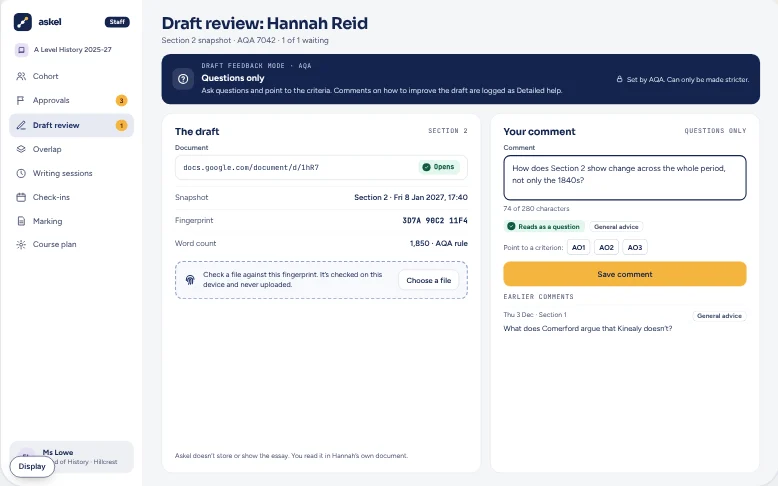
The essay stays where your school keeps it, for example in OneDrive or Google Drive. Askel keeps a link and a fingerprint of each draft.
Board dates are fixed. Your school’s dates are Askel’s defaults, and you can change them.
AI tools, like ChatGPT, can write or change text for you. JCQ’s rules apply to every board: students say which AI tools they used, and keep their prompts and what the tool gave them. Each board adds its own notes.
Askel has no AI in it, and never sends students’ work to AI companies.
We’ll tell you when History reaches pilot, and ask what you need first. Pilot schools can move a subject up the order.
We check these again each September, when the JCQ documents change. Spotted something out of date? Tell us.
Kept in this browser only. No cookie, and it isn’t linked to you.