Boards
- At every board
- AQA, OCR, Pearson and WJEC/Eduqas
LaterGCSE Design and Technology, Engineering and Electronics.Planned order, not dates.
All 14 subjectsSee the build orderAskel tracks every student against every CPAC criterion over two years, and builds the pack for the monitor’s visit. CPAC means the common practical assessment criteria.
Planned order, not dates. Pilot schools can move a subject up.
See the build orderOne summary, because the rules are shared.
| Rule | At every board |
|---|---|
| Boards | AQA, OCR, Pearson and WJEC/Eduqas |
| Subjects | A Level Biology, Chemistry and Physics |
| What students are judged on | 5 criteria, across at least 12 practicals |
| Result | Pass or Not classified |
| Monitoring | One monitoring visit per two-year cycle |
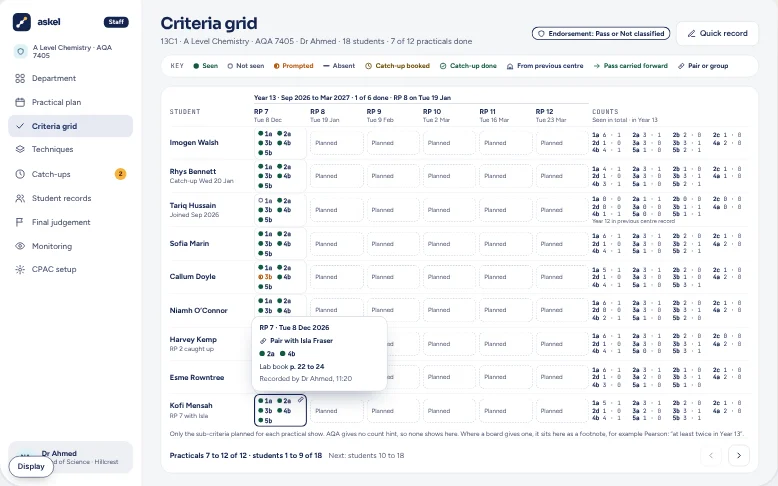
Every student against every criterion, across Year 12 and Year 13.
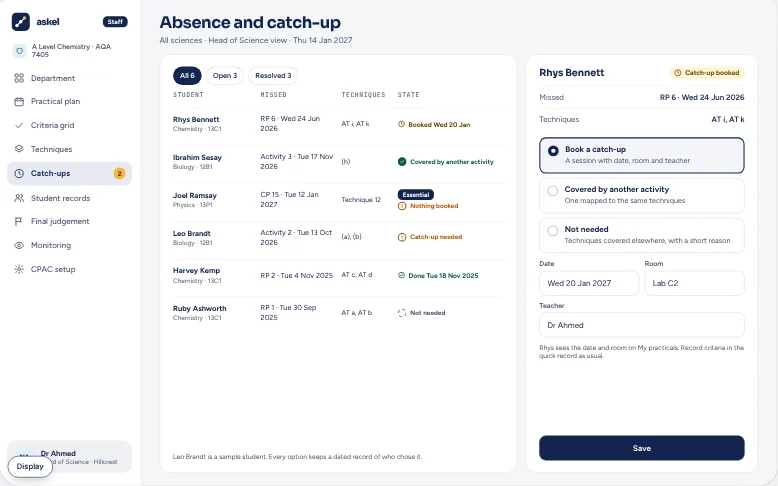
Students who miss a practical need another chance.
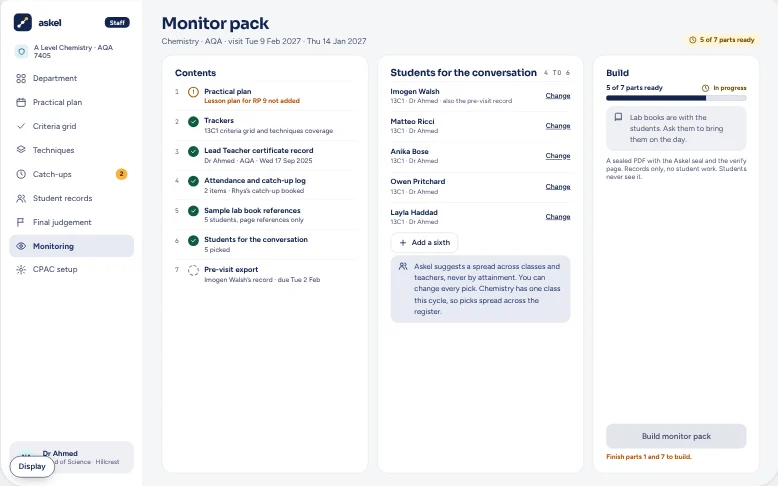
Records have to be ready when the monitor asks.
Every feature sits under one of the five steps.
A grid of every student against every criterion.
Who missed a practical, and when they caught up.
Where the evidence is in each lab book.
The records a monitor asks for, in one place.
Lab books stay in the lab. Askel keeps page references and dates.
CPAC runs across Year 12 and Year 13.
AI tools, like ChatGPT, can write or change text for you. JCQ’s rules apply to every board: students say which AI tools they used, and keep their prompts and what the tool gave them. Each board adds its own notes.
Askel has no AI in it, and never sends students’ work to AI companies.
We’ll tell you when Science practical endorsement reaches pilot, and ask what you need first. Pilot schools can move a subject up the order.
We check these again each September, when the JCQ documents change. Spotted something out of date? Tell us.
Kept in this browser only. No cookie, and it isn’t linked to you.